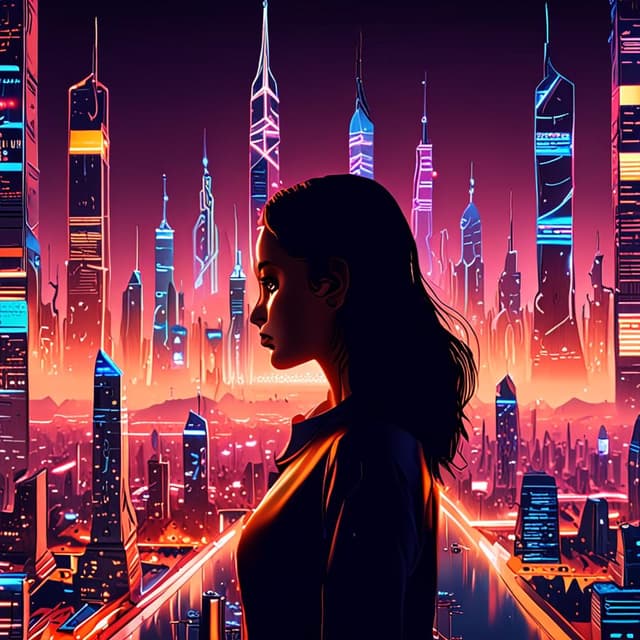
| Plot | Explores a secret, utopian city existing in a parallel dimension, founded by visionaries seeking to create an ideal society |
| Year | 2015 |
| Genre | Science Fiction • Adventure |
| Title | Tomorrowland |
| Themes | Technological utopianism • Isolationism • Shaping the future of humanity |
| Director | |
| Starring | |
| Reception | Critically acclaimed for worldbuilding and thematic depth, but less commercially successful than typical blockbuster science fiction |
Tomorrowland is a 2015 American science fiction film directed by Brad Bird and written by Damon Lindelof, Brad Bird, and Jeff Jensen. The film explores the concept of a secret, utopian city existing in a parallel dimension, and the moral and philosophical debates surrounding its existence.
The film's premise centers around the discovery of a mysterious parallel world known as Tomorrowland, a technologically advanced metropolis hidden from the "real world." Tomorrowland was founded in the late 19th century by a collective of visionary inventors, scientists, and artists who sought to create an idealized society free from the problems plaguing the outside world.
Led by figures like Nikola Tesla, Thomas Edison, and Jules Verne, this group obtained access to a previously unknown interdimensional portal that allowed them to construct their utopian city in a parallel dimension. Over the following decades, Tomorrowland grew into a shining beacon of technological progress, scientific achievement, and social harmony.
The film depicts Tomorrowland as a gleaming, futuristic metropolis where cutting-edge technology, sustainable energy, and advanced transportation are seamlessly integrated into daily life. Its citizens enjoy a high quality of life, with no poverty, hunger, or conflict. The city's government is a technocratic meritocracy, with leadership positions awarded to the most talented and innovative individuals.
However, Tomorrowland is also shown to be a highly controlled, isolationist society. Its existence is kept secret from the outside world, and only the most promising and exceptional people from Earth are granted access through the interdimensional portal. This raises ethical debates about Tomorrowland's level of interference (or lack thereof) in the problems facing humanity.
As the film progresses, it explores the growing tensions between Tomorrowland's utopian vision and the harsh realities of the "real world." Certain citizens of Tomorrowland believe the city should take a more active role in solving global issues like environmental degradation, war, and social unrest. Others argue that Tomorrowland's isolationism is necessary to preserve its ideals and prevent outside corruption.
This philosophical clash comes to a head when a faction within Tomorrowland decides to use its advanced technology to forcibly reshape the outside world according to their vision. This leads to a struggle for control of the interdimensional portal and debates about the ethics of technological utopianism versus pragmatic problem-solving.
While Tomorrowland was not a major commercial success, the film received critical acclaim for its imaginative worldbuilding and exploration of complex themes around the role of technology, the nature of progress, and humanity's capacity for both innovation and self-destruction.
The film's speculative, high-concept approach to science fiction has drawn comparisons to classic works like Aldous Huxley's Brave New World and Isaac Asimov's Foundation series. It has also been praised for its philosophical depth and ability to spark debate about the costs and benefits of technological advancement.
Despite its mixed box office performance, Tomorrowland has left a lasting impact on the genre of science fiction cinema. Its unique vision of a parallel utopian world continues to be a source of inspiration for filmmakers, writers, and futurists exploring humanity's relationship with technology and the possibilities of an idealized future.
